
Context
The organisation needed a smoother way to manage visitors arriving at its buildings. The experience involved more than simply checking someone in.
There were multiple participants:
- Visitor needs to register and arrive.
- Receptionist needs to prepare the building and manage arrivals.
- Host needs to know when their visitor has arrived.
This made the project a multi-user service experience, rather than a single interface.
Understanding the Journey
I mapped the visitor experience from before arrival through to check-in.
Existing opportunity
A visitor already has a meeting invitation.
Instead of asking the visitor to complete all their information at reception, the system could use that existing interaction as the starting point.
Proposed journey

This significantly reduces the amount of work required at reception.
Receptionist Experience
The receptionist has a completely different set of needs. The system needs to support the receptionist before visitors arrive.
Proposed journey

This meant the design needed to account for different visitor states rather than assuming every visitor follows the same journey.
Design Thinking
One of the key design decisions was to move work earlier in the journey.
Instead of:
Visitor arrives → completes registration → waits → host is contacted
the experience becomes:
Meeting invitation → pre-registration → arrival → QR scan → host notified
This is an example of reducing friction by changing when an interaction happens, rather than simply making the interaction itself easier.
Multiple User Needs
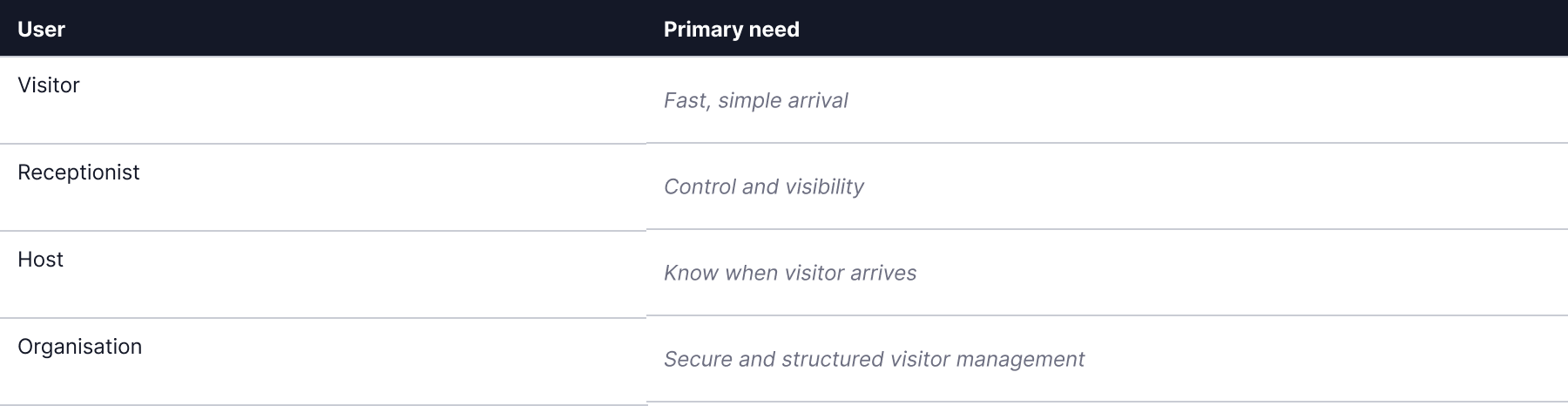
The design therefore had to balance convenience, operational efficiency and organisational requirements.
What I learned
This project reinforced the importance of designing the whole service, rather than a single screen.